What is a Cnc Machine and How Does It Work?
CNC machines are revolutionizing the manufacturing industry. According to a report by the International Federation of Robotics, the use of CNC machines has grown by 30% in the last five years. This growth highlights their increasing importance in production efficiency.
Renowned industry expert Dr. Emily Carter states, “CNC machines transform designs into reality with precision.” This level of accuracy is crucial for companies striving to maintain competitive edges. These machines automate tasks, reducing human error. However, reliance on technology raises concerns about skills gaps in the workforce.
While CNC machines enhance productivity, they require proper operation and maintenance. Companies need skilled personnel to manage these systems efficiently. Poor training can lead to mistakes that negate the benefits of automation. Understanding the potential of CNC machines involves recognizing both their capabilities and the need for continuous operator education.
What is a CNC Machine?
CNC machines play a crucial role in modern manufacturing. CNC stands for Computer Numerical Control. These machines automate processes like milling, drilling, and cutting with precision. According to reports from the International Federation of Robotics, the global CNC machine market is expected to reach $100 billion by 2025. This indicates a growing reliance on automated systems.
The core function of a CNC machine is to accept a digital model and translate it into physical form. Operators create a design using CAD software. The machine then follows coded instructions. This reduces human error, leading to high accuracy. However, this technology is not without challenges. Operators must understand both the software and the machinery. Inadequate training can lead to inefficient production and increased costs.
Many companies face difficulties in integrating CNC systems. A recent survey showed that 30% of manufacturers struggle with machine setup. These hurdles highlight the need for ongoing training and support. Proper implementation brings many benefits, including reduced waste and faster turnaround times. However, the transition can be complex and requires careful planning. As the industry evolves, prioritizing education and skill development remains essential.
What is a Cnc Machine and How Does It Work?
| Feature |
Description |
| Definition |
A CNC machine (Computer Numerical Control) is a machine operated by a computer that creates precision parts by controlling the movement of tools. |
| Key Components |
Controller, Stepper Motor, Power Supply, Tools, and the Workpiece. |
| Types of CNC Machines |
CNC milling machines, CNC lathes, CNC routers, CNC laser cutters, etc. |
| Working Principle |
CNC machines interpret a computer-aided design (CAD) file and execute a programmed set of instructions to control the movement of tools. |
| Applications |
Used in industries for manufacturing parts, prototypes, and engravings in various materials such as metal, plastic, and wood. |
| Advantages |
High precision, reduced waste, ability to produce complex shapes, and increased production speed. |
| Limitations |
High initial costs, requires skilled operators, and limitations on material types. |
The History and Evolution of CNC Technology
The history of CNC (Computer Numerical Control) technology dates back to the 1940s. Early developments focused on automating machining processes. Initial systems used punched cards for control. This innovation revolutionized manufacturing by increasing precision and efficiency. In the 1960s, advancements introduced computer technology, allowing more complex designs. CNC machines became the backbone of modern manufacturing by the 1980s.
According to industry reports, the global CNC machine market is projected to reach $100 billion by 2026. This growth indicates a strong demand for precision engineering. Moreover, the emergence of Industry 4.0 has brought further advancements. Smart factories now leverage CNC technology integrated with IoT devices, enhancing real-time monitoring and data analytics capabilities.
Tip: Always stay updated on CNC trends. New software and hardware developments can significantly impact production efficiency.
As CNC technology continues to evolve, manufacturers must reflect on their practices. Relying solely on automation can lead to skill gaps in the workforce. Balancing advanced technology with human expertise is crucial. Local labor markets may need support to adapt to these changes.
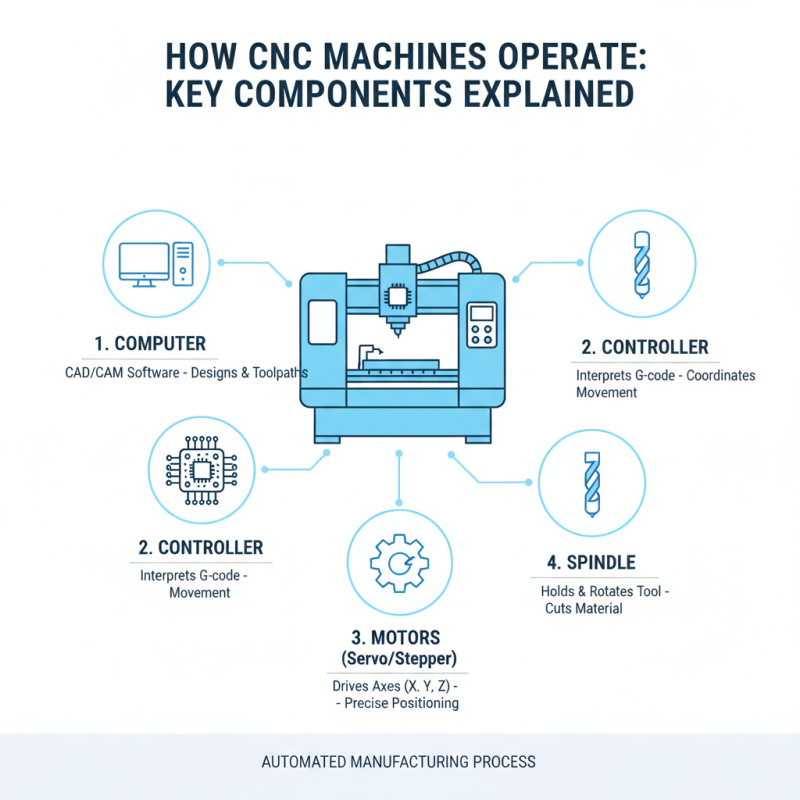
How CNC Machines Operate: Key Components Explained
CNC machines are fascinating tools that automate manufacturing processes. They operate using a combination of hardware and software components. The main parts include the computer, controller, motors, and spindle. Each plays a unique role in machine function.
The computer runs the CAD (Computer-Aided Design) software. This software creates the designs that the CNC machine will follow. The controller interprets this design data and sends commands to the machine. Motors drive the mechanical movements, allowing precision in cutting or shaping materials. The spindle is crucial, as it holds the cutting tool and rotates at high speeds.
Despite their advanced technology, CNC machines can have limitations. Programming errors can lead to incorrect cuts or wasted materials. Regular maintenance is necessary to keep them operating efficiently. Understanding the key components helps users troubleshoot issues. The complexity of these machines might be overwhelming at first, but familiarity grows with practice. Embracing these challenges leads to better outcomes in the long run.
Applications of CNC Machines in Various Industries
CNC (Computer Numerical Control) machines play a crucial role in various industries. Their precision and efficiency have made them indispensable. According to a report by Markets and Markets, the global CNC machine market is expected to reach $117.21 billion by 2027. This growth reflects the rising demand across sectors like aerospace, automotive, and healthcare.
In the aerospace industry, CNC machines are used to create complex components with tight tolerances. These parts are critical for ensuring safety and performance in flight. The automotive industry has also benefited significantly. A study indicated that about 50% of automotive companies have adopted CNC technology for parts production. This adoption improves efficiency and reduces waste, although challenges remain, such as the need for skilled operators.
The healthcare sector applies CNC technology for manufacturing surgical instruments and implants. The precision required in medical applications is paramount. Nonetheless, integrating CNC machines can be costly, and not all facilities can afford the latest models. There’s a continuous need for innovation to reduce costs while maintaining quality. As these industries evolve, the reliance on CNC machines will likely deepen, yet obstacles to widespread adoption still exist.
Applications of CNC Machines in Various Industries
Future Trends and Innovations in CNC Technology
CNC technology is advancing rapidly. According to a recent market report, the global CNC machine market is expected to reach $100 billion by 2026. This growth highlights the ongoing innovations in the industry. The focus is now on smarter and more efficient machines.
One notable trend is the integration of artificial intelligence. AI improves machining processes, enhancing precision and reducing waste. Furthermore, Industry 4.0 is pushing for more automation and connectivity. Machines are not just tools; they are becoming part of larger systems. This connectivity allows real-time monitoring and predictive maintenance, which can minimize downtime.
Sustainability is becoming a priority as well. Manufacturers aim to reduce their carbon footprints. New technologies are emerging to create energy-efficient CNC machines. However, this shift poses challenges. Companies must balance innovation with cost-effectiveness. There is pressure to adapt quickly, but not every business can keep pace. The future of CNC technology is promising, yet complex.